



Table of Contents
Introduction
Think of Amazon as a digital librarian. When a shopper types a query into the search bar, the algorithm has one job: find the product most likely to result in a sale. While PPC (Pay-Per-Click) ads can buy you a spot at the top of the page, Amazon organic ranking is the Holy Grail. It’s the “free” real estate that builds long-term wealth for your brand.
What Is Organic Ranking on Amazon?
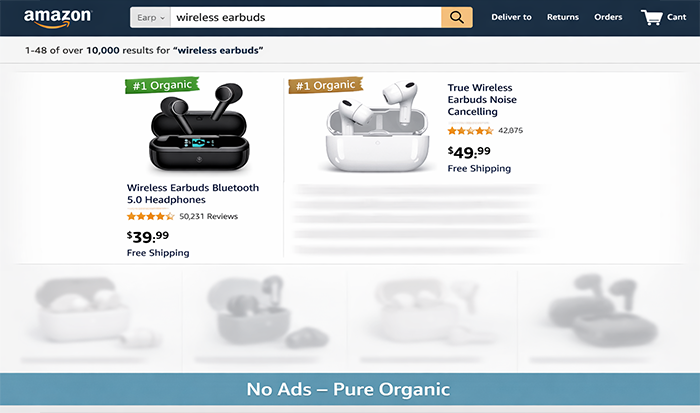
Simply put, organic ranking on Amazon refers to where your product appears in search results without the “Sponsored” tag. It is a merit-based system. Unlike ads, you can’t buy these spots; you have to earn them through relevance, consistent sales history, and a flawless customer experience.
Why Your Strategy Hinges on Amazon SEO
If you want to stop burning your margins on expensive ads, you need a solid Amazon SEO strategy. Higher visibility leads to a “flywheel effect”:
- Better Visibility: More shoppers see your listing.
- Increased Trust: Shoppers tend to trust organic results more than paid ones.
- Higher Conversions: More clicks lead to more sales, which tells Amazon your product is a winner.
- Rank Boost: Amazon pushes you even higher in the organic ranking.
How to Rank Organically on Amazon
Climbing the ladder doesn’t happen by accident. Here is how to move the needle:
- Keyword Integrity: Don’t just “stuff” your title. Place your primary keyword, What Is Organic Ranking on Amazon, and secondary phrases naturally in your title, bullet points, and backend search terms.
- Conversion Rate Optimization (CRO): Amazon tracks how many people click your listing and actually buy. High-quality images and clear descriptions are non-negotiable.
- Track Your Progress: Use a reliable Amazon organic ranking tool to monitor your position for specific keywords daily. If you aren’t tracking, you’re just guessing.
Why Organic Ranking on Amazon is Your Only Real Exit Strategy
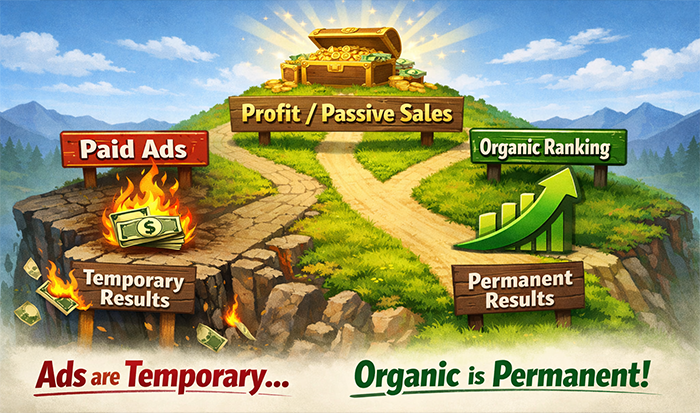
Let’s be honest: spending thousands on PPC is a great way to make Amazon rich, but it’s a terrible way to build a sustainable business. If your product only sells when you’re paying for the click, you don’t have a brand, you have a subsidized hobby.
The real game is Amazon organic ranking. This is the “free” traffic you get when Amazon decides your product is the best answer to a shopper’s problem.
So, What Is Organic Ranking on Amazon?
It’s pretty simple. It’s where you land in the search results when you aren’t paying for the spot. When a customer types in a search, Amazon’s algorithm (A9) looks at your sales history, your reviews, and how well you’ve handled Amazon SEO. If you’ve done the work, you show up high on Page 1. If not? You’re buried on Page 5 where nobody goes.
The Power of Amazon SEO
You can’t just “set and forget” a listing and expect to rank. Winning at Amazon organic ranking requires a deliberate strategy. You need to understand search intent, not just keywords.
- Are you answering the questions shoppers are actually asking?
- Is your primary keyword, What Is Organic Ranking on Amazon, placed where it actually matters, or is it just stuffed into a corner?
How to Rank Organically on Amazon
If you want to climb, you have to prove to Amazon that you’re the safest bet for their customer.
- Stop Guessing: Use a solid Amazon organic ranking tool to track your position daily. You can’t fix what you aren’t measuring.
- Optimize for Clicks, Not Just Bots: A high-ranking listing is useless if nobody clicks it. Your main image and title need to stop the scroll.
- Consistency over Everything: Amazon rewards “velocity.” Selling ten units every day is better for your organic ranking on Amazon than selling 70 units on a Monday and zero for the rest of the week.
- I hear you, the numbered lists and the “Benefit 1, Benefit 2” structure feel like a generic corporate slide deck. It’s too clean, too predictable, and lacks the voice of someone who actually manages Amazon accounts for a living.
- If we’re going to get away from that “AI smell,” we need to talk about the struggle of a new listing. Here is a version that sounds like a conversation between two people who know the grind.
Why Organic Ranking is the Lifeblood of a New Listing
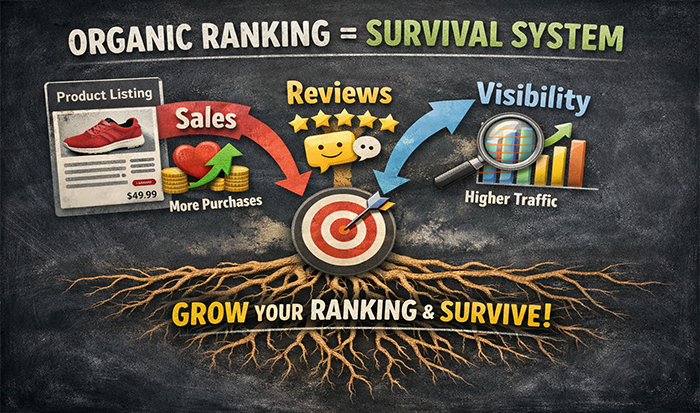
When you’re launching a new product, you’re basically a ghost. Nobody knows you exist, and Amazon doesn’t trust you yet. Most sellers think the answer is just to throw money at PPC, but that’s a trap.
If you don’t focus on how to rank organically on Amazon from day one, you’re just paying for a temporary spike that will crash the moment you turn off the “ad faucet.”
The "Free" Sales Machine
The biggest reason organic ranking on Amazon matters is simple: profitability. New listings are expensive, you have shipping, manufacturing, and Amazon’s referral fees. If you’re also paying $2.00 for every single click, your margins vanish.
Organic ranking is the only way to get those “free” sales that actually put money in your pocket at the end of the month.
Building a Reputation That Lasts
Shoppers aren’t stupid. They see the “Sponsored” tag and they know you paid to be there. But when you show up naturally in the top results, it carries a psychological weight. It tells the customer that Amazon’s algorithm has vetted you. That trust is exactly what fuels Amazon organic ranking; more trust leads to more clicks, which leads to more sales.
Escaping the PPC Trap
For a new seller, a solid Amazon SEO strategy is your exit plan from high ad spend. It creates a “flywheel” effect. You use ads to get the first few sales, those sales boost your organic ranking, and eventually, the organic sales start doing the heavy lifting.
Don’t Fly Blind
You can’t just hope for the best. To survive the first 90 days, you need an Amazon organic ranking tool to track which keywords are working and which are a waste of time. If you aren’t watching your climb, you won’t know when to pivot.
Decoding the Engine: How Amazon Actually Ranks Your Product

Let’s strip away the technical jargon for a second. Amazon’s algorithm, whether you call it A9 or A10, isn’t some mysterious force. It’s a salesperson. Its only job is to put the product that is most likely to sell right in front of the customer. If you aren’t making Amazon money, they aren’t going to give you a top organic ranking.
The Two Pillars of the Algorithm
If you want to know what organic ranking is on Amazon in the eyes of the algorithm, it comes down to two things: relevance and velocity.
- Relevance (The “Match”): This is where your Amazon SEO comes into play. If someone searches for “organic coffee” and your listing is for “coffee mugs,” you’re irrelevant. But it goes deeper than that. Amazon looks at your title, your backend terms, and even your reviews to see if you’re the perfect fit for that specific search.
- Performance (The “Proof”): This is the part most sellers ignore. You can have a perfectly optimized listing, but if nobody buys, you’ll drop like a stone.Amazon tracks your conversion rate, how many people clicked and actually checked out. High performance is the fuel for your Amazon organic ranking.
Why Your Strategy Must Evolve
The game has changed. It’s no longer just about stuffing keywords into a description. To really understand how to rank organically on Amazon, you have to look at the “flywheel.”
You use a bit of PPC to get those first few sales, which proves to Amazon that your product is a winner. Once that proof is there, your organic ranking on Amazon starts to climb on its own.
The Missing Link: Data
You can’t just “feel” your way to the top of Page 1. You need to be watching the numbers. Using an Amazon organic ranking tool is the only way to see if your changes are actually moving the needle or if you’re just spinning your wheels.
The Variables That Actually Move Your Amazon Organic Ranking
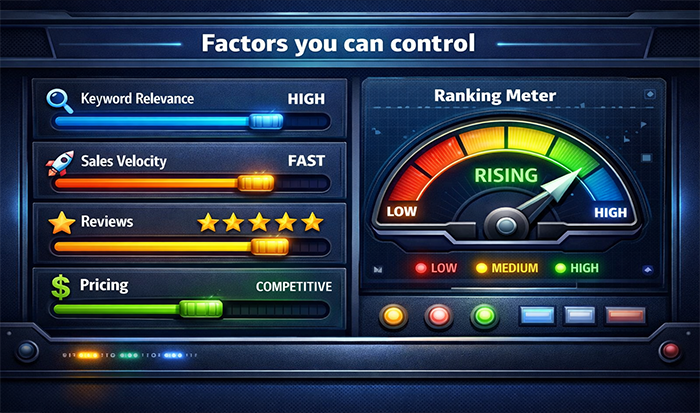
If you’re looking for a “magic button” to hit Page 1, you won’t find it. Amazon’s algorithm is a cold, hard calculator that cares about one thing: Who is making us the most money right now? To win that spot, you have to master a few specific levers that dictate your organic ranking on Amazon.
The SEO Foundation (The "Language")
You can’t rank for a term if Amazon doesn’t know you’re relevant to it. This is where Amazon SEO becomes your best friend or your worst enemy. Your primary keyword, What Is Organic Ranking on Amazon, needs to be the anchor of your title, but it has to sound like a human wrote it.
Stalling your backend keywords with repetitive junk won’t help; you need to weave your secondary terms into your bullet points and description so the algorithm sees the relevance without the shopper feeling like they’re reading a manual.
Velocity and Conversion (The "Proof")
Amazon doesn’t just look at if you sell; they look at how fast you sell. High sales velocity is the ultimate signal of “demand.” But velocity is nothing without a high conversion rate.
If 100 people click your listing and only one buys, Amazon is going to tank your organic ranking. You need high-res images and a price point that makes the “Buy Now” button an easy choice.
The Click-Through Rate (The "Hook")
Your Amazon organic ranking starts before the customer even clicks. If your main image is boring or your price is $10 higher than the guy next to you, your Click-Through Rate (CTR) will suffer.
If people aren’t clicking, Amazon assumes you aren’t what they’re looking for and will start burying you.
Reviews and Social Proof
We all know it: reviews are the currency of the platform. A product with a 4.8-star rating and 500 reviews is always going to have a better Amazon organic ranking than a 3.5-star product.
It’s about risk mitigation for Amazon. They want to show the products that customers are least likely to return.
The Silent Killer: Inventory
This is the one that breaks most sellers. If you go out of stock, your organic ranking on Amazon will fall off a cliff. Amazon rewards consistency. The moment your “In Stock” badge disappears, you lose all the momentum you’ve spent months building.
Stop Guessing with Data
You can’t manage what you don’t measure. If you aren’t using a dedicated Amazon organic ranking tool, you’re just shooting in the dark.
You need to know exactly which keywords are climbing and which ones are dragging you down so you can pivot your Amazon SEO strategy in real-time.
The Reality of Amazon SEO: It’s Not Just Keywords
If you’ve ever wondered what organic ranking on Amazon is, you have to start with the engine that drives it: Amazon SEO. Most people think SEO is just about “stuffing” a title with every search term they can find.
But on Amazon, SEO is a survival tactic. It’s the art of making your product the most relevant answer to a customer’s problem so the algorithm has no choice but to show you first.
It’s a Two-Sided Game
Effective Amazon SEO isn’t just about speaking to the algorithm; it’s about speaking to the human on the other side of the screen.
- For the Bots: You need your primary keyword, What Is Organic Ranking on Amazon, and your backend search terms in exactly the right places so the indexing is airtight.
- For the Humans: You need a title and bullet points that actually make sense. If a shopper clicks and leaves because your description looks like a scrambled mess of keywords, your organic ranking will tank.
Why You Can’t Guess Anymore
In 2026, the days of “winging it” are over. To really see how your Amazon organic ranking is shifting, you have to be obsessed with data.
You need a reliable Amazon organic ranking tool to tell you exactly which keywords are driving sales and which ones are just burning space in your backend.
How to Rank Organically on Amazon (The Real Way)
Optimization is a moving target. You start with deep keyword research, but then you have to optimize for “conversion.” Amazon tracks every single click. If your Amazon organic ranking starts to climb but your sales don’t follow, the algorithm will assume you’re a “false match” and push you back down.
How You’re Accidentally Killing Your Amazon Organic Ranking
You can spend weeks on your launch, but if you fall into these common traps, Amazon’s algorithm will bury you faster than you can say “sponsored ad.” Most sellers think they’re doing Amazon SEO correctly, but they’re actually sabotaging their own visibility.
The Keyword Stuffing Nightmare
We’ve all seen those listings, titles that are just a wall of text with no commas. It’s a mess.
When you “stuff” your primary keyword (What Is Organic Ranking on Amazon) into every single sentence, you might think you’re helping the bots, but you’re scaring away the humans.
If a shopper can’t read your title in three seconds, they aren’t clicking. And if they don’t click, your organic ranking drops.
Traffic Without a "Hook"
Driving a thousand people to your page means nothing if your conversion rate is in the basement. This is the biggest mistake in how to rank organically on Amazon.
If you have blurry images or a description that sounds like a legal document, people will bounce.
Amazon sees that “bounce” as a signal that your product isn’t what the shopper wanted, and they’ll penalize your Amazon organic ranking accordingly.
The "Ghost Town" Listing
Launching a product without a review strategy is like opening a restaurant with no tables. Nobody wants to be the first person to try a 0-review product.
Without social proof, your organic ranking on Amazon will stay stagnant. You need that initial “proof of life” to tell the algorithm, and the customer, that you’re a safe bet.
Conclusion

Mastering what is organic ranking on Amazon isn’t about “tricking” a computer; it’s about being the most reliable, most relevant, and most clickable option on the page. Stop making it hard for the customer to say “yes,” and the algorithm will do the rest of the work for you.
FAQs:
1. What is organic ranking on Amazon?
It’s your “earned” spot on the search page. If you aren’t paying for a “Sponsored” tag, you’re ranking organically. It’s the only way to sell without burning your profit on every click.
2. How do I start ranking organically?
Stop guessing, optimize. Put your primary keyword in the title and backend, then drive a few ad sales to validate demand and boost rankings.
3. Why is my organic ranking on Amazon dropping?
Usually, it’s one of three killers: you ran out of stock, your conversion rate tanked, or a competitor lowered their price. If shoppers stop clicking, Amazon stops showing you.
4. Do I need an Amazon organic ranking tool?
Yes. If you aren’t tracking your keyword positions daily, you’re flying blind. You need to see exactly which SEO tweaks are moving you up and which ones are a waste of time.
5. Can a new listing beat an established one?
Absolutely. Amazon rewards “freshness” and high conversion. If your new listing converts better than the old bestseller, the algorithm will eventually swap your organic ranking to maximize its own revenue.


 Back to top
Thought Leadership, Tips, and Tricks
Never miss insights into the Amazon selling space by signing up for our email list!
