

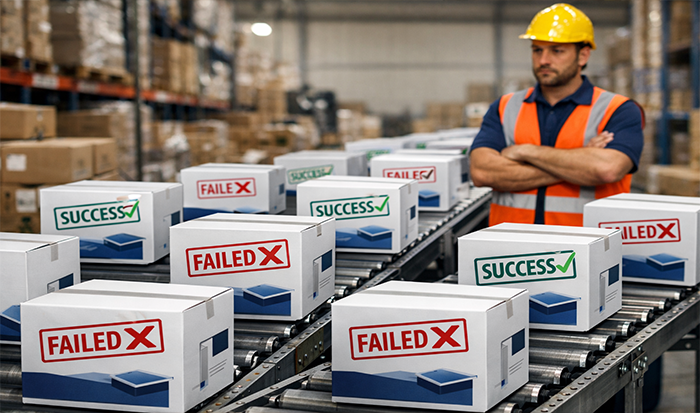
Why This 2026 Launch Data Matters
If you have launched even one product on Amazon, you already know the hard truth: a launch can look promising in week one and still fade by week six. That is exactly why the Amazon Product Launch Success Rate matters more than most sellers admit. A good launch is not just about getting traffic or running ads. It is about building enough momentum, fast enough, to convince Amazon that your new ASIN deserves visibility.
This Sellerite-style report looks at what separates a strong Amazon New Product Launch from one that stalls out early. We are not talking about launch hype or cherry-picked screenshots. We are looking at the signals that tend to show up again and again in winning launches: early sales velocity, conversion quality, review growth, and the ability to hold rank after the initial push.
The reason this matters in 2026 is simple. Launching on Amazon is more competitive than ever, with new ASINs appearing at scale and buyers having more options in nearly every category. One 2026 launch analysis notes that more than 100,000 new ASINs are listed daily, while less than 5% reach the top 100 in their category within 30 days. That does not mean launching is hopeless. It means New Product Launch Success now depends much more on execution quality than on luck.

How We Define Amazon Product Launch Success Rate
What “success” actually means here
For this report, Amazon Product Launch Success Rate does not simply mean “the product went live.” It means the launch showed enough healthy traction to suggest the product is not just surviving, but earning its place in the market.
We are looking at a mix of practical indicators:
- Early sales velocity during the first 30 to 90 days.
- Conversion rate strong enough to support ranking growth.
- Review velocity, not just star rating.
- Organic traffic share improved after the initial ad push.
- Profitability potential after ad spend begins to normalize.
That last point is important. A launch can generate revenue yet still be unhealthy. If it depends on aggressive discounts, unstable ads, or unsustainable margins, it may look successful on the surface while quietly becoming a bad business decision.
Why launch benchmarks matter in 2026
The 2026 environment is making launches more unforgiving. Amazon’s guidance emphasizes launch planning, performance monitoring, and coordinated ad strategy, as new products need quick traction to scale. At the same time, broader launch data outside Amazon shows that new product success is never automatic.
One 2026 benchmark roundup notes that 66% of new products fail within two years, while high-performing companies dramatically outperform average ones on launch outcomes.
So when we talk about Amazon Product Launch, we are really talking about controlled risk. The best sellers do not assume every new ASIN will win. They use signals early, cut weak ideas faster, and scale the ones that show strong response.
What The 2026 Data Suggests About Launch Success
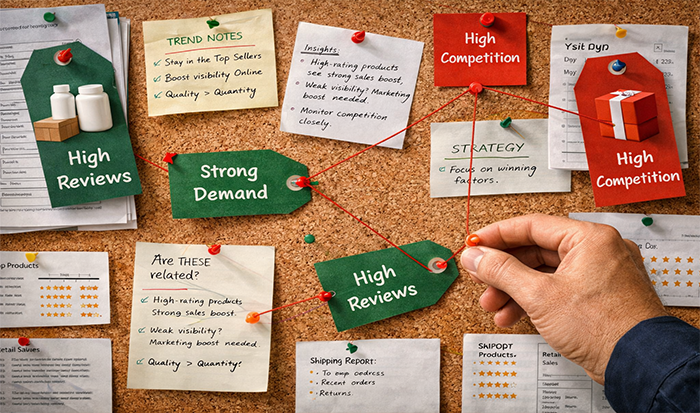
The first 30 days still matter most
The first month remains the most sensitive part of any Amazon New Product Launch. This is where Amazon starts reading the product’s performance pattern. If traffic comes in and converts, your listing earns a better chance at ranking. If traffic comes in and bounces, that momentum weakens quickly.
A detailed 30-day 2026 case study shows what this can look like in practice. In that example, a new product climbed into the top 10 of its category in 30 days, finished with 6,800 total sales, reached 72% organic traffic share by day 30, and improved conversion from 8% to 10% after listing optimization. That kind of result is obviously above average, but it gives us a useful picture of what a high-performing launch tends to have: quick traffic, fast optimization, and organic momentum that begins replacing paid dependence.
Conversion is the clearest early filter
One of the most useful 2026 benchmarks is conversion rate. Ad Badger’s 2026 update says average Amazon conversion across product types tends to hover around 9% to 11%, while well-optimized listings with strong reviews often land in the 10% to 15% range. A 2026 Amazon launch guide also suggests tracking launch conversion daily and treating 8% to 12% as a realistic target for new products, with higher rates becoming more achievable once the product is established.
That gives us a useful way to think about launch health:
- Below 8%: the listing or offer likely needs work.
- Around 8% to 12%: early launch is in a workable zone.
- Above 12%: strong sign of product-market alignment if traffic quality is solid.
This is one reason experienced sellers obsess over listing quality before launch. A weak title, unclear images, or poor pricing can quietly kill momentum before the product has a real chance to rank.
Amazon Product Launch Success Rate At A Glance
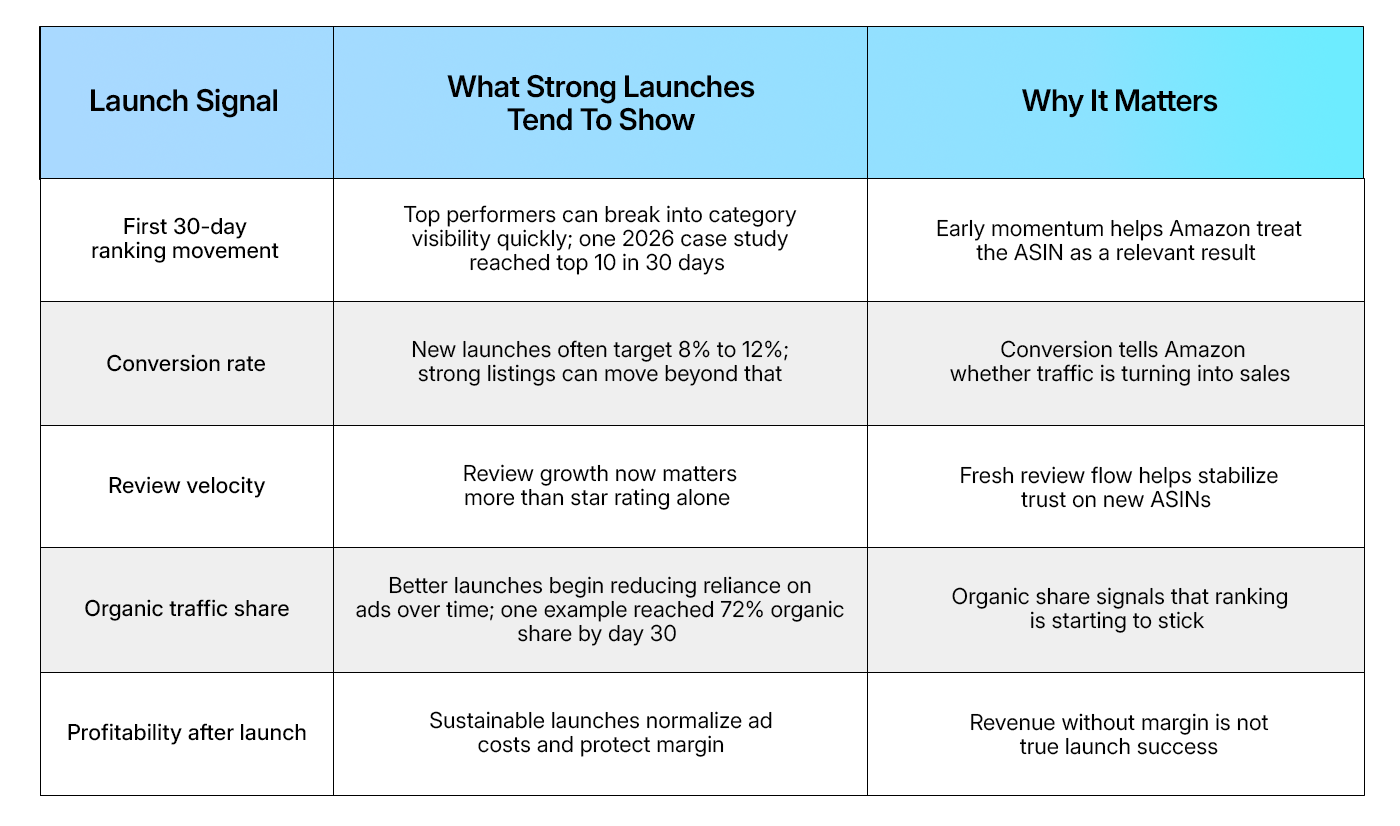
This table is useful because it shows something many sellers miss: New Product Launch Success is rarely one metric. It is usually a pattern. You want multiple signals moving in the right direction at the same time.
What Usually Separates Winners From Weak Launches
Strong launches build trust faster
One of the biggest patterns in 2026 launch data is that top-performing products reduce uncertainty quickly. They do not leave the customer guessing. The images are clear, the value proposition is obvious, and the offer feels believable.
Winning launches usually have:
- Better listing readiness before day one.
- Cleaner keyword targeting from the start.
- Faster response to weak conversion signals.
- Review generation momentum through a better buyer experience.
On the other hand, weaker launches often spend heavily without fixing the page itself. That creates a painful pattern: traffic rises, costs rise, but conversion stays soft.
Reviews matter, but review speed matters more
A useful 2026 insight is that star ratings alone are not as predictive as many sellers think. A 2025 launch analysis looking ahead to current conditions found that both top performers and average launches often reached similar star ratings after three months. The bigger difference was review velocity.
That makes sense. A brand-new ASIN with a steady stream of credible reviews tends to feel alive, current, and trusted. A product with a decent rating but almost no recent review movement feels much less convincing.
Where Sellers Misread Amazon Product Launch Success

A lot of launch mistakes come from reading the wrong signals too early.
Common traps include:
- Assuming impressions mean demand.
- Treating ad-driven sales as proof the launch is healthy.
- Looking only at revenue and ignoring margin.
- Waiting too long to improve a weak listing.
- Confusing a good first week with long-term traction.
The better approach is to treat launch data like a conversation. If conversion is weak, the market is telling you something. If review growth is slow, that tells you something too. Good sellers listen early instead of defending the product emotionally.
A Sellerite-Style Workflow For Better Launch Odds
If you want to improve your own Amazon Product Launch Success Rate, a cleaner workflow helps more than a louder launch.
A practical approach looks like this:
- Validate demand before inventory commitment using keyword and category data.
- Launch with a conversion-ready listing, not a “we’ll fix it later” page.
- Track daily signals in the first month: sessions, conversion, units, review growth, and ranking movement.
- Adjust fast if the traffic is there, but the page is not converting.
- Scale only when the economics still make sense after ads.
That is the mindset behind smart Amazon New Product Launch execution in 2026. You are not just launching a product. You are testing whether the market is willing to reward it, then reacting quickly enough to build on the answer.
What This Means For Your 2026 Launch Strategy

The big takeaway from this Amazon Product Launch Success Rate report is straightforward: successful launches are still possible, but they are becoming more selective. The market is crowded, early momentum matters, and conversion quality is doing a lot of the sorting.
If there is one practical lesson here, it is this: stop treating Amazon Product Launch as a single event. In 2026, it works better as a managed performance window. The winners are usually the sellers who prepare harder before launch, measure better after launch, and fix weak signals before they become expensive habits.
For Sellerite users, that means using launch data as an operating system. Watch conversion, watch review velocity, watch organic share, and do not confuse noise with traction. When those signals line up, New Product Launch Success becomes far more predictable than it looks from the outside.
